Viren und Bakterien
Virus
Diesen Artikel gibt es noch nicht auf Deutsch, er wird auf Englisch angezeigt.
Viruses are among the smallest biological particles that cause disease. They can infect living organisms such as humans, animals and plants. Some viruses make us sick, while others can provide medical benefits and play a major role in the ecosystem.

What is a virus?
A virus is the smallest known biological particle that can cause disease. However, not all viruses cause disease; in fact, some viruses are infectious and can harm us, but also those that are medically beneficial. Certain viruses, known as bacteriophages, can for example be used against multi-resistant bacteria.
Some viruses have been around for hundreds of years, while others have just been discovered in humans. Those that have been around for a long time are generally less dangerous to humans, while some mutations, like SARS-CoV-2, can be more aggressive.
Preventing a viral infection
It is impossible to completely avoid the risk of infection, but there are steps you can take to reduce it.
Prioritize good hand hygiene by washing your hands thoroughly with liquid soap, especially before meals, after touching your eyes and mouth, and after contact with potentially infected people. Use hand sanitizer as a supplement, especially when soap and water are not available. Avoid close contact with infected people and reduce the risk of indoor transmission by frequent ventilation, being outdoors and avoiding crowded indoor environments. Maintain a healthy lifestyle by eating well, getting enough sleep, exercising and reducing stress and alcohol consumption to strengthen the immune system. Emphasize the importance of vaccination against infectious diseases such as influenza when it is particularly important to avoid infection.
Treatment for viral infection
Today there are two main ways to combat viral infections: vaccines, which prevent infection, and antivirals, which treat it. Common viral infections such as colds or flu that are not considered as serious usually go away on their own and do not need treatment.
Vaccine
Vaccines contain a weakened or inactivated virus, or a small part of it. When a vaccine is given, the body’s own immune system reacts to it and produces cells and antibodies that can fight the real virus later on. Vaccines are often very effective, but to prevent infection by viruses, they must be used before the virus reaches the body.
How do viruses spread?
Viruses can spread in many different ways, depending on the type of virus. However, a virus cannot move on its own and needs help to get to the host cell it is supposed to infect. The most common source of infection for a virus is generally humans.
In human-to-human transmission, viruses can infect in several different ways:
Airborne droplets
Many viruses are spread by droplet transmission, i.e. small drops of liquid released when an infected person coughs, sneezes or talks, for example. If an uninfected person inhales these droplets, they can become infected. Examples of viruses spread in this way include influenza virus, SARS-CoV-2 (coronavirus), rhinovirus and RSV.
Research has also shown that there are two types of cells in the nose that COVID-19 primarily attacks to infect the body. These cells act as “entry receptors” for the coronavirus and are particularly vulnerable due to their location in the nose, where we can breathe in droplet contamination.
By wearing a face mask, you can protect others around you from your droplet infection. You can also use NOSA Microbial Control to reduce your exposure to viruses and bacteria.
Direct contact
Some viruses are spread through direct contact with the body fluids of an infected person. This can happen by touching the skin of an infected person, kissing or having sexual contact. Examples of such viruses include herpes simplex virus and HIV.
The virus can also be spread through indirect contact with objects or surfaces contaminated with the virus. If a person touches an infected surface and then touches their face, such as their eyes, nose or mouth, the virus can be transmitted. An example of a virus that can be spread in this way is norovirus, which is often associated with stomach infections.
Food and water
Some viruses can be transmitted through contaminated food or water. If food or water is contaminated with viruses and consumed, a person can become infected. Examples of such viruses include hepatitis A-virus and norovirus.
Blood-borne infections
Some viruses are also transmitted through blood and blood-mixed body fluids. Common viruses that can be transmitted through blood are hepatitis B, hepatitis C and HIV.
Different types of viruses
There are many different types of viruses and at least 600 diseases caused by viruses that we know of today. However, new viruses are constantly emerging and, according to virus researcher Ali Mirazimi, many of these are likely to have originated in the animal world.
Some viruses are more common than others and some of these are also more aggressive and therefore more contagious.
Norovirus
Norovirus is a common cause of stomach illness or stomach flu. It is a virus that spreads easily and can spread quickly in closed communities such as schools, airplanes, public transport, workplaces, hospitals and homes. Norovirus can be troublesome and unpleasant, but for most healthy people it is usually not dangerous or life-threatening.
The norovirus is highly contagious and you only need to come into contact with a few particles to get sick.
The virus can be spread through everything from contaminated food to indirect or direct contact with an infected person. A common source of infection is buffets that serve unheated food. This is because the virus in the food otherwise dies when the food is heated.
Norovirus can also be spread through contaminated water, such as drinking water contaminated with sewage. Contact with a sick person can also pose a high risk of spreading the virus.
NOSA microbial control has been shown by external lab tests to reduce Norovirus by up to 93% in contact with the product.
Symptoms
It takes up to two days for the virus and disease to appear. Common symptoms of norovirus are:
diarrhea, nausea, vomiting and stomach pain.
In some cases, fever, headache and dizziness may also occur.
Coronavirus (SARS-CoV-2)
COVID-19 is the disease caused by the coronavirus SARS-CoV-2, which was discovered in 2019. The virus can infect several different types of cells, including the lungs, airways, intestines, kidneys and brain.
The coronavirus that causes COVID-19 disease is contagious. For the vast majority of healthy people it is not serious, but for some it can lead to severe illness and even death.
There is now a vaccine against COVID-19 that can alleviate the infection and protect you from serious illness and death. NOSA microbial control has been shown by external lab tests to reduce Coronavirus by up to 93% in contact with the product.
There are several symptoms that indicate COVID-19, the most common being a respiratory infection but other symptoms can also occur. Common symptoms include runny nose, sore throat, fever, changes in taste and smell, cough, difficulty breathing and joint pain.
The vast majority of people only experience symptoms for a few days and are often mild. For some, however, the symptoms can become severe and, in the worst cases, persistent.
Rhinovirus
Many of the viruses that exist can cause colds. The vast majority of these viruses belong to the rhinovirus group. The common cold is very contagious, especially during the first few days when the disease produces symptoms. The virus can be transmitted through direct contact but it is also airborne and can be transmitted through coughing or sneezing (droplet transmission).
A cold is a less serious illness. Usually you are not sick for more than a few days and in most cases no treatment is required.
Colds can manifest themselves in many ways, including runny nose, sore throat and cough. Many people often experience a persistent cough that is initially dry but gradually becomes more mucousy. Some also experience fatigue, fever, and pain in the sinuses and ears.
Calicivirus
Caliciviruses, which include norovirus and sapovirus, cause winter vomiting disease, which spreads quickly and easily. It is most common between November and April. Hence the name ‘winter vomiting’. The virus usually causes stomach upset and nausea and is sometimes referred to as norovirus infection.
Winter vomiting is the most common stomach disease in Sweden. It can be spread through food and contaminated water but also through direct and indirect contact with an already infected person.
The symptoms of winter vomiting usually appear very quickly, but in most cases you are only sick for one or two days. Symptoms that indicate winter vomiting are:
vomiting, diarrhea, nausea, body aches, fever and headache.
The RS virus
RSV is another cold virus that can affect both children and adults. However, the symptoms are often much more severe in children, and can even be life-threatening in the worst cases. The infection affects almost all children during the first two years of life.
For the vast majority of children, the disease starts as a common cold. However, for some children, the virus can develop and cause a respiratory infection. For some children, this can be life-threatening if not treated in time.
Most often, an RSV infection presents itself as a common cold. However, some children, especially younger children under 6 months of age, may have more severe symptoms. Usually the symptoms last from a few days to six days, but for some it takes longer than that to recover.
Common symptoms of RSV include a runny nose, nasal congestion and fever. Some children also refuse to eat and drink, which in turn can lead to fatigue. More serious symptoms can include difficulty breathing.
Bacteria and viruses
There are many similarities between viruses and bacteria but also some fundamental differences. The main difference is that viruses cannot reproduce themselves without infecting a host cell, while bacteria can reproduce themselves by division.
Bacteria are almost everywhere; in us, around us, on our skin, in our mouths, in our bodies, on the ground and so on. Most bacteria are beneficial and do us humans good but there are also those bacteria that can be harmful and make us sick.
Bacteria that make us sick are called pathogenic and can cause diseases such as pneumonia and urinary tract infections. Read more about bacteria.
Unlike bacteria, viruses need a living tissue to reproduce. Like bacteria, there are both good and bad viruses. However, the most talked about ones are those that cause disease and can harm us. Two common diseases caused by viruses are colds and flu.

Frequently asked questions (FAQ)
Can you prevent viruses?
It is difficult to completely avoid getting infected by a virus as they are around us all the time, but there are things you can do to reduce the risk of getting infected by a virus.
On the one hand, vaccines can be used to prevent and, in the best case, help you avoid getting sick from a virus. Antivirals can also be used to treat an ongoing virus infection.
Many of the viruses we are exposed to today are spread via droplet infection that reaches us through the air or through hands that then come into contact with sensitive mucous membranes and infect us. To reduce exposure to viruses, you can use a nose or mouth guard. However, regular face masks are most effective in protecting people around you from your droplet infection.
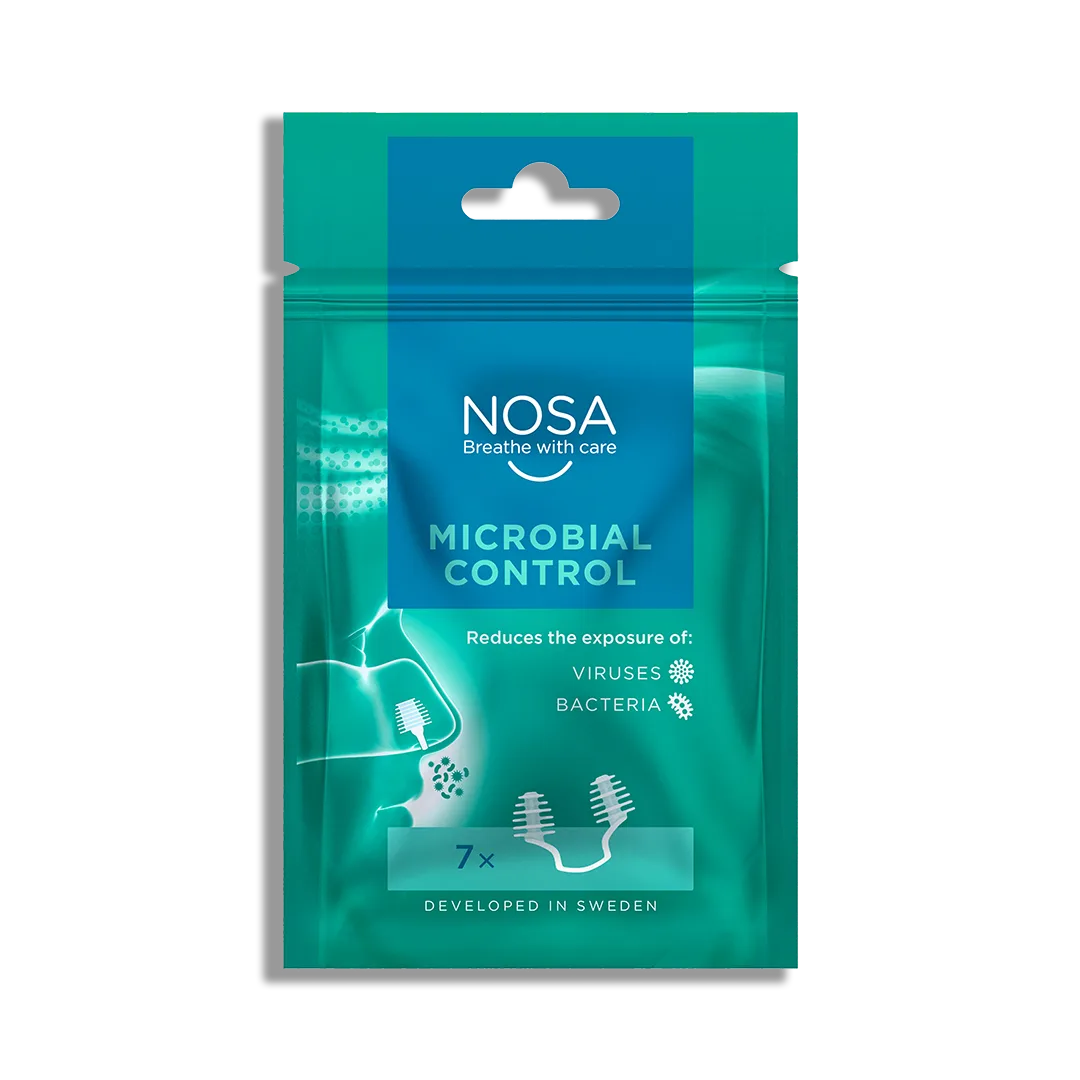
NOSA microbial control is a nasal protection that reduces the user’s exposure to viruses and bacteria by inactivating viruses and killing bacteria in contact with the product. A reduced amount of active viruses and bacteria reduces the risk of respiratory infections. This is possible because the product contains silver sulphate particles encapsulated in the material. Reduced exposure to viruses has been shown to reduce the risk of respiratory infections.
Which viruses is NOSA microbial control tested against?
External lab tests have shown that NOSA microbial control can reduce exposure to coronavirus, rhinovirus, adenovirus and norovirus by up to 93% in contact with the product.
The product’s design forces air to pass through the lamella structure, inactivating viruses and killing bacteria that come into contact with the product. This is possible because the product contains silver sulfate particles encapsulated in the material. This reduces the amount of active viruses and bacteria that pass to the upper respiratory tract.
NOSA microbial control is a CE marked medical device, class I and is sold in Europe.
 Passendes ProduktNOSA Microbial ControlReduziert die Exposition gegenüber Viren und Bakterien.